
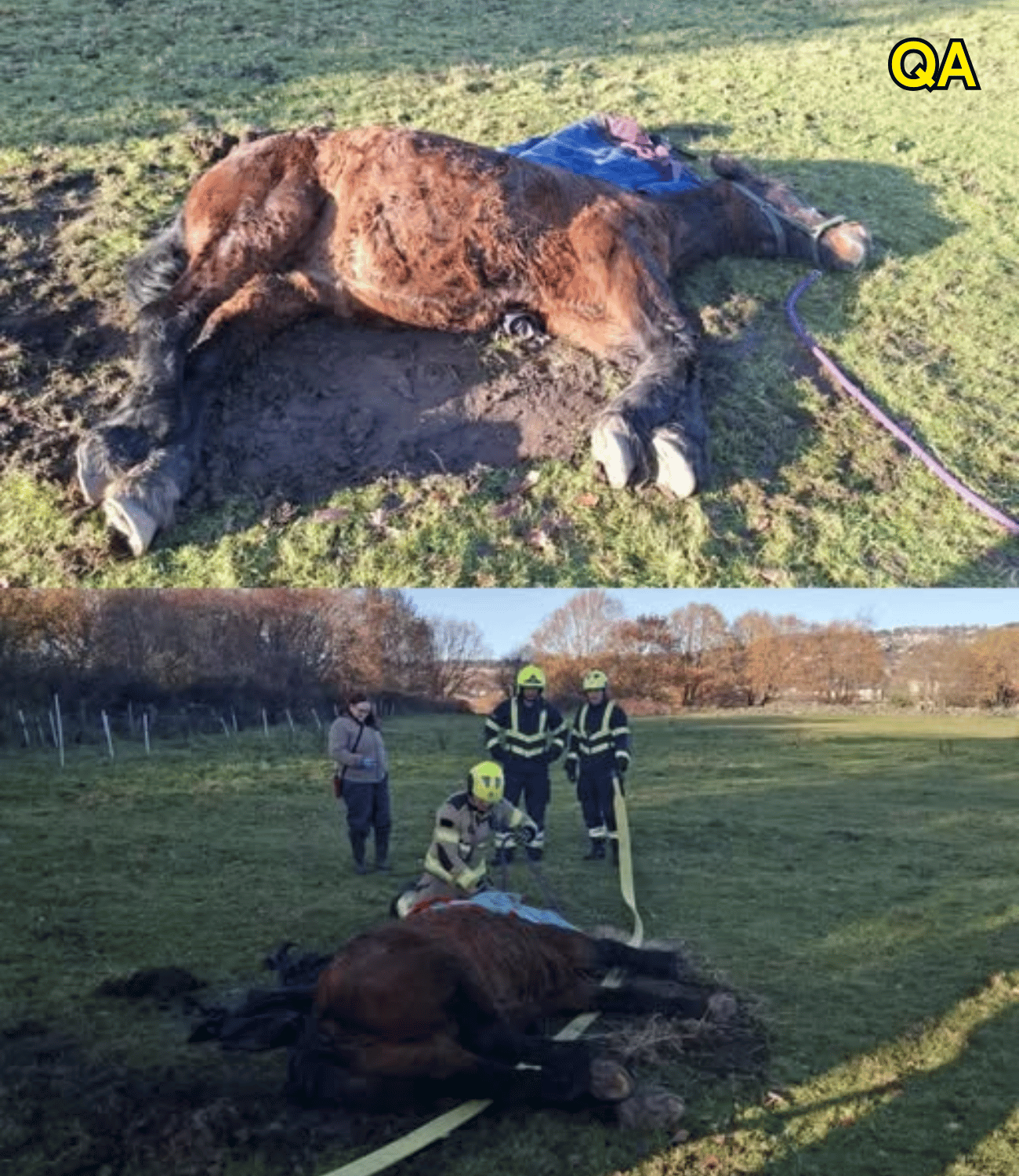
At 30 years old, Tiggy had already enjoyed three decades of life, countless peaceful mornings, and many quiet days grazing in the field she called home.
But one morning, everything changed.
Sometime during the night, the elderly mare collapsed in her pasture and became unable to stand again. By the time daylight arrived, she had already spent hours lying on the cold ground, exhausted and frightened.
Her owner tried everything to encourage her to get back on her feet. Gentle words, familiar voices, and even the comforting touch of having her head resting in a lap were not enough.
Tiggy simply couldn’t rise.
For horses, remaining down for an extended period can become extremely dangerous. Prolonged pressure on their muscles and internal organs can lead to serious complications, making a situation like this a race against time.
Realizing that Tiggy needed more help than one person could provide, her owner made an urgent call for assistance.
What followed was an extraordinary rescue involving firefighters, a specialist technical rescue team, and a veterinarian—all determined to give the elderly mare another chance.

Firefighters Arrive to Help a Horse in Trouble
When the local firefighters arrived, they found Tiggy lying in the damp field.
They approached carefully, assessing her condition and trying to understand whether she could move on her own.
It quickly became clear that simply encouraging her to stand would not be enough.
Tiggy was an elderly, large animal who had already spent hours unable to get up. Any rescue attempt needed to be carefully planned to avoid causing additional injuries.
The Spen Valley specialist technical rescue team was therefore called to assist.
Carrying specialist equipment across the field, the rescuers prepared for a more complicated operation. Their equipment included lifting straps and other gear designed to help move heavy loads safely.
The first approach was gentle.
The team tried repositioning Tiggy onto her other side, hoping that changing her position would relieve pressure on her body and give her another opportunity to stand naturally.
But despite their efforts and encouragement, the mare remained unable to get her legs underneath her.
Her condition was becoming increasingly concerning.
A Veterinarian Joins the Rescue
With time running short, a veterinarian arrived to assess Tiggy.
The team needed to determine the safest way to lift her without putting unnecessary pressure on her body.
A mechanical lifting approach was prepared.
A wide lifting strap was carefully positioned around Tiggy’s hindquarters. Every movement was deliberate, with the rescuers working together to support her weight and reduce the risk of injury.
Around ten firefighters gathered to assist.
At the veterinarian’s signal, the team began lifting.
Slowly, Tiggy’s body rose from the ground.
For everyone watching, those moments must have felt incredibly tense. After hours of trying to stand without success, the elderly mare was finally getting the support she needed.
Then came the moment everyone had been hoping for.
Tiggy was back on her feet.
The Moment Tiggy Finally Stood Again
At first, the mare appeared unsteady.
Her legs trembled as she adjusted to standing, and the rescuers remained close to make sure she was supported.
But she was upright.
The people surrounding her continued offering gentle reassurance, stroking her mane and giving her time to regain her balance.
They also brought out some of her favorite treats, including carrots and mint imperials.
Slowly, Tiggy appeared more settled.
Her posture improved, her ears lifted, and she was able to remain standing on her own four legs.
After such a frightening night, seeing the elderly mare upright again was an enormous relief for everyone involved.
Her owner could finally breathe a little easier, while the firefighters had the satisfaction of knowing their teamwork had helped an animal in desperate need.
A Rescue Made Possible by Teamwork and Compassion
Tiggy’s rescue was more than a difficult lifting operation.
It was an example of how emergency responders can make a difference in situations that have nothing to do with fires or road accidents.
Large-animal rescues require patience, specialist knowledge, suitable equipment, and close cooperation with veterinary professionals.
Simply pulling or lifting a horse without the right support can cause further harm. That is why careful planning and veterinary guidance are so important.
In Tiggy’s case, the coordinated efforts of her owner, the local firefighters, the Spen Valley technical rescue team, and the veterinarian helped give her the chance to stand again.
Once the operation was complete, Tiggy remained in her owner’s care.
The sight of the elderly mare standing in her field was a welcome outcome after hours of uncertainty.
Why Helping a Fallen Horse Is So Important
A horse that cannot stand should always be treated as an urgent veterinary concern.
Unlike some smaller animals, horses can develop serious complications when they remain lying down for prolonged periods. The weight of their bodies can place significant pressure on muscles and other tissues, potentially causing additional damage.
There are many possible reasons why a horse might collapse or become unable to rise, including injury, neurological problems, severe illness, or age-related conditions.
Getting veterinary help quickly is essential.
A rescue team may be needed to assist with lifting, but the animal’s underlying condition must also be assessed. Standing up is an important milestone, not necessarily proof that the danger has passed.
That is why Tiggy’s story highlights the importance of both emergency response and continued veterinary care.
A 30-Year-Old Mare Given Another Chance
For three decades, Tiggy had enjoyed the simple routines of life in her pasture.
On that frightening morning, it looked as though she might never stand in her field again.
But her owner refused to give up, and the people who arrived to help worked together until they found a way to lift her safely.
There were no dramatic speeches or grand celebrations—just muddy boots, specialist equipment, careful hands, and a group of people who understood how much one animal’s life mattered.
Tiggy’s rescue is a reminder that compassion does not have to be limited to the animals we can easily carry or care for ourselves.
Sometimes, helping a life in need takes an entire team.
And sometimes, the most rewarding sight of all is an old horse standing once more, surrounded by the people who refused to leave her behind.