
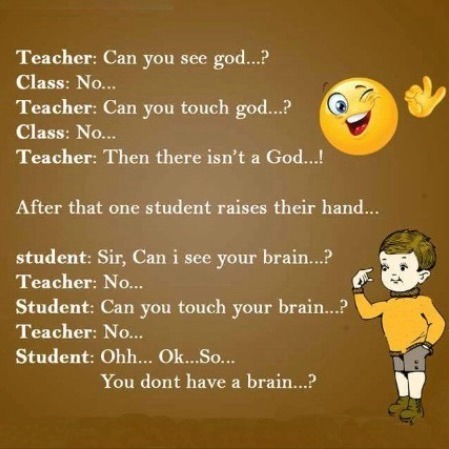
There’s a timeless charm in the way children see the world — pure, literal, and unfiltered. It’s this innocence that often leads to moments of unintentional comedy, where a child’s reasoning exposes just how tangled and overcomplicated adult logic can become. The story of the six-year-old girl who challenged her teacher’s “proof” that God doesn’t exist is one of those perfect moments — funny not because of clever wordplay, but because it reveals the kind of truth that only a child could see so clearly.
Let’s look at what makes this story so funny — and why, decades later, it’s still shared across classrooms, dinner tables, and the internet as one of the most delightful examples of “out of the mouths of babes.”
The Story That Started It All

It begins simply: a classroom discussion about belief, science, and what can or cannot be seen. The teacher, perhaps hoping to teach logic and critical thinking, uses a classic argument to explain her point.
“Tommy,” she says, “do you see the tree outside?”
“Yes.”
“Do you see the grass?”
“Yes.”
“Go outside and look up and see if you can see the sky.”
“Yes, I saw the sky.”
“Did you see God?”
“No.”
“That’s my point,” the teacher says confidently. “We can’t see God because He isn’t there. He doesn’t exist.”
It’s a neat, tidy conclusion — one that works only if no one questions the underlying assumption that “seeing” is the same as “proving.”
But then, from the back of the class, a little girl raises her hand. She’s small, curious, and bold in the way only a six-year-old can be. “Can I ask Tommy some questions?” she says. The teacher agrees, maybe thinking this will reinforce her point.
The girl turns to Tommy. “Do you see the tree?”
“Yes.”
“The grass?”
“Yes.”
“The sky?”
“Yes.”
“Do you see the teacher?”
“Yes.”
“Do you see her brain?”
“No.”
“Then,” the girl declares triumphantly, “according to what we were taught today… she must not have one!”
Why We Laugh

That final punchline lands perfectly — a mix of innocence, cheekiness, and razor-sharp reasoning that disarms both the teacher and the listener. But why does it make us laugh every single time we hear it?
1. It’s pure reversal — a child using adult logic better than the adult.
The humor here lies in inversion. The teacher assumes that because she’s the authority figure, her logic will stand unchallenged. But the little girl flips that logic right back on her — using the exact same reasoning to reach a hilariously absurd conclusion. The idea that “if you can’t see it, it doesn’t exist” collapses instantly when applied to something as simple as a human brain.
We laugh because the child doesn’t intend to be sarcastic — she’s applying what she’s just learned in a perfectly straightforward way. The humor doesn’t come from cruelty or disrespect; it comes from clarity. Her mind, unclouded by adult nuance, finds a truth that’s both funny and surprisingly profound: not everything that matters can be seen.
2. It reveals how children view authority — with fearless honesty.

Kids have a unique relationship with authority. They respect it, but they also test it constantly. The little girl’s question isn’t rebellion; it’s curiosity. She wants the world to make sense, and when it doesn’t, she points it out.
Adults, on the other hand, often tiptoe around authority — we hesitate to question, we choose politeness over honesty. Children don’t have that filter. That’s what makes their reasoning so refreshing. It’s funny because we, as adults, recognize how rarely we speak with that kind of unfiltered truth. The little girl says what every adult in that room might have thought — but would never dare to say.
3. It’s a reminder that “childish” doesn’t mean “foolish.”
One of the reasons this story stays with people is that it flips another common assumption: that children are naïve and adults are wise. In this case, it’s the child who uses logic correctly and the adult who trips over her own reasoning.
The humor is mixed with admiration. We laugh, yes — but we also feel a spark of pride for the child who dared to speak up. There’s a universal joy in watching innocence outsmart intellect, not because the adult is wrong maliciously, but because she forgot how simple truth can be.
4. It plays on the timeless “literal kid” trope.
Children are wonderfully literal. Tell them the moon is made of cheese, and they’ll start wondering whether it’s cheddar or Swiss. This story leans on that same charm. The little girl doesn’t question the teacher’s logic emotionally or theologically — she takes it at face value and applies it to another situation.
That literalism is what makes it funny. Her mind works like a mirror — reflecting the adult’s words back exactly as they were given, but revealing their flaws in the process. The teacher wanted to sound wise; the child just wanted to understand. The contrast between those intentions makes the humor sparkle.
5. It reminds us of the joy of curiosity.
Children’s curiosity is boundless. They ask questions not to challenge authority, but to fill the gaps in their understanding. That’s what makes this little girl’s line so brilliant — it’s not meant as an insult. It’s a question that reveals the limitations of the teacher’s argument, made with genuine curiosity and honesty.
In that sense, the laughter this story provokes is also affectionate. We’re not laughing at the teacher or the child; we’re laughing with the situation — at the way logic, innocence, and curiosity collide to produce a moment of pure comedy.
Why These Stories Stick With Us
Humor has a strange way of sticking to wisdom. The best jokes don’t just make us laugh — they make us think. This one does both beautifully. Beneath the giggles lies a profound message: the human experience can’t be reduced to what we can see or measure. Love, faith, imagination — these are invisible, yet they shape every part of who we are.
That’s why stories like this live on across generations. They aren’t just funny anecdotes about precocious kids; they’re miniature parables about perspective. They remind us to question our assumptions, to stay humble, and to never underestimate the insight of a curious mind.
Laughter as a Bridge Between Worlds
The beauty of this moment is that it bridges two worlds — the serious, rule-bound world of adults and the free, wonder-filled world of children. In that small classroom, those worlds collided for an instant, and laughter became the bridge.
When the class laughed, it wasn’t cruel laughter. It was joyous — a shared recognition that the child had said something deeply true in the funniest possible way. Even the teacher, once she recovered, likely smiled. Because beneath the embarrassment, there’s something disarming about being reminded that logic isn’t everything — and that a child’s innocent reasoning can sometimes make more sense than a grown-up’s sophisticated argument.
The Takeaway
We laugh at this story not because it’s silly, but because it’s real. It captures that delicate balance between innocence and intellect — between seeing the world as it is and as it could be. Children remind us that simplicity can be powerful, and that humor can reveal truth in ways logic never could.
So, the next time a child says something that catches you off guard — something bold, blunt, or unexpectedly wise — resist the urge to correct them. Listen. Laugh. Think. Because within that laughter lies a mirror — one that reflects not just a child’s unfiltered view of the world, but also a glimpse of the wisdom we adults may have forgotten.
Sources:
-
Child Development Review — “Why Kids’ Logic Feels Funny but Reveals Deep Truth”
-
Psychology Today — “The Science of Why We Laugh at Children’s Honesty”
-
National Education Journal — “Humor and Critical Thinking in the Classroom”